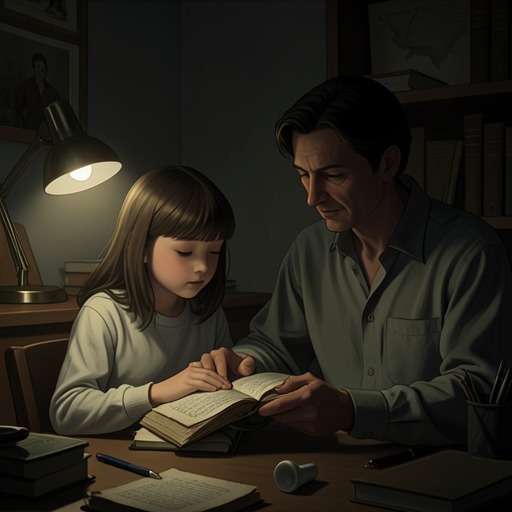
Esther Greenwood's father's death
The Bell JarEsther Greenwood's father's death is an early family loss that remains emotionally unreal to Esther until she visits his grave years later and mourns him for the first time. The delayed grief gives the death a continuing presence in her life: what the family once treated as settled returns as an unexpressed loss that Esther must finally face.
Death and Family Background
Esther’s father died in November 1940 after a long, difficult illness. In the biographical account accompanying the novel, this is described as a radical change in Sylvia Plath’s life: following the death, her mother and grandparents moved the family inland from Winthrop to Wellesley, a conservative upper-middle-class suburb of Boston. The family’s circumstances changed, but Esther’s own account emphasizes what the loss left unexplained and ungrieved.
As a child, Esther was not allowed to attend her father’s funeral. He had died in the hospital, and the graveyard remained distant from her experience; his death consequently seemed unreal. The gap between the fact of his death and Esther’s understanding of it is central to the later scene. The loss is not absent from her history, but its emotional meaning has been postponed.
Esther imagines the life that might have continued had her father lived. She thinks he would have taught her about insects, his specialty at the university, and would have passed on the German, Greek, and Latin he knew. She also imagines that she might have become a Lutheran: her father had been Lutheran in Wisconsin, then, as Esther understands it, became a lapsed Lutheran and eventually an atheist after moving to New England. These possibilities make the death more than a biographical fact; it represents an interrupted inheritance of knowledge, religious identity, and closeness.
The Return to the Grave
When Esther finally goes to the cemetery, she wears a black veil and enters through its wrought-iron gates. She is struck by the thought that none of the family had visited her father during all the years since his burial. Her mother had kept the children away from the funeral, and the hospital death had helped leave the place—and the death itself—outside Esther’s lived memory.
Esther now feels a strong desire to make up for years of neglect by tending the grave. She had always been her father’s favorite, and she decides that it is fitting for her to take up the mourning her mother had not undertaken. The visit is therefore not simply a belated family duty: Esther gives herself a role in the grief, attempting to establish a bond with her father through an act of care.
The graveyard does not offer a consoling setting. It lies at the outskirts of town on low ground, and Esther describes its crowded graves and the stagnant salt marshes in the distance. Her father’s pink-marble stone is pressed close to another; it bears his name and two dates separated by a dash. Esther places azaleas she has picked at the gateway at its foot, then sits in the wet grass as her legs fold beneath her. The small ritual of flowers brings the loss into the present, but it does not make the grief manageable.
Delayed Mourning and Its Consequences
At the grave, Esther recognizes that she has never cried for her father’s death. She remembers that her mother did not cry either. Instead, her mother had described the death as merciful, believing that if he had lived he would have been crippled and an invalid for life, a condition he could not have endured. The account Esther received thus framed his death through the suffering it supposedly spared him, while leaving her own grief unspoken.
Now Esther presses her face against the smooth marble and cries out her loss into the cold salt rain. The force of the scene comes from the contrast between the child who was kept from the funeral, the daughter who arrived years later intending to tend the grave, and the mourner who discovers that the grief has not passed simply because it was never expressed. The visit turns an unreal, inherited fact into a bodily experience of bereavement.
The novel’s remembered death also resonates with Esther’s later crises, without making those crises a simple consequence of her father’s death. The book’s opening places Esther’s troubled summer alongside the execution of the Rosenbergs, while the retrospective account identifies her father’s death as an earlier rupture in Plath’s life. In both contexts, death enters Esther’s awareness in a form she cannot easily put aside. At the grave, however, the loss is personal and specific: she names what she did not grieve and gives it expression at last.
Narrative Significance
The episode presents mourning as belated rather than complete or immediate. Esther’s father’s death took place years before the cemetery visit, but the narrative makes the decisive emotional event her recognition that she has never cried for him. The sequence moves from estrangement—the funeral she did not attend and the graveyard that seemed unreal—to a deliberate attempt at care, and finally to an outpouring of grief. Its emotional change lies not in reversing the death, but in allowing Esther to acknowledge the loss.
The grave scene also complicates the family’s account of the death. Her mother’s explanation presents it as merciful in view of the disability and lifelong dependence she believes would have followed; Esther’s grief does not directly refute that judgment, but it reveals what such an explanation could not contain. A death may be understood as relief from suffering and still be a profound loss to those left behind. By placing Esther’s face against the stone, the narrative gives that unaccommodated loss its own moment of witness.